The Night Richard J. Daley Bought NBC for JFK:
Friday, November 4 1960
Video from the Vault of Rich Samuels
Curator's
note: Click here
if you wish to skip the introductory material and proceed directly
to the video of which there are three parts. The entire broadcast
runs sixty minutes. Will Barack
Obama ever acquire a television
presence as powerful as the one John F. Kennedy projected half a century ago? Will the Cook County Democrats ever again sponsor a coast-to-coast political broadcast? |
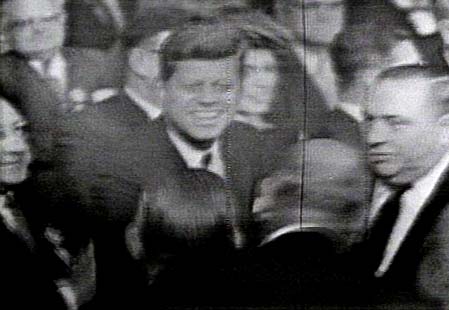 |
Above:
Presidential candidate Senator John F. Kennedy and Chicago's Mayor
Richard J. Daley on the floor of the Chicago Stadium shortly after
8:30pm on Friday, November 4th, 1960. In the background you can
see his sister, Eunice Kennedy Shriver. |
 |
Much
has been made of Richard J. Daley's efforts to ensure that Senator
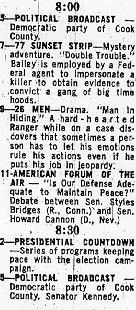
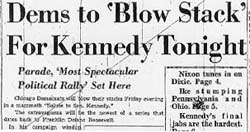
John F. Kennedy prevailed at the polls on November 8th, 1960. A key---though largely undocumented---element of that effort was the purchase of half an hour of prime time on the NBC television network by the Democratic Party of Cook County so that the nation could watch J.F.K. addressing a wildly enthusiastic crowd at the Chicago Stadium on the Friday before the election. It is normal for local political organizations to purchase time locally to promote candidates. But for a local organization to purchase national television time is a rarity indeed. What viewers from coast-to-cast saw the night of February 4th, 1960, was Senator John F. Kennedy at his best, thanks to a local party organization at its most powerful. |
Viewers
within range of WNBQ-TV (Chicago's NBC owned-and-operated station
now known as WMAQ-TV) saw an additional half-hour that preceded
the Kennedy speech---the culmination of what might have been the
ultimate "torch light parade" honoring not only the head
of the ticket but its state and local components as well. |
|
Richard
J. Daley's purchase of the 8-8:30 half hour on Channel 5 had the
added benefit of locking the Republican national organization out
of the Chicago market during prime time that night. In all other
markets, the Republicans purchased this slot on NBC for an address
by President Dwight D. Eisenhower on behalf of presidential candidate
Richard M. Nixon. Since the Cook County Democrats had already bought
this time period, the Republicans had to settle for a tape-delayed
broadcast of the Eisenhower speech at 10:15---well after prime-time---following
WNBQ's late evening news. Both half-hours are remarkable examples
of stagecraft and scripting and of Richard J. Daley's ability to
target demographic groups that were essential to the victories of
his party. Both half-hours are remarkable examples of stagecraft and scripting and of Richard J. Daley's ability to target demographic groups that were essential to the victories of his party. Present-day political gurus would do well to study this video. |
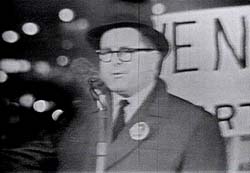 |
Hosting
the broadcast was Vince Garrity (seen on the left). Vincent Depaul
Garrity was a life-long loyal Democrat (some might call him a party
hack) who served, for time, as a trustee of the Metropolitan Sanitary
District (now known as the Water Reclamation District). Vince was also a Chicago radio personality: in the 1960's he was morning man on WAAF radio. (The NBC announcer is Greg Donovan). |
Watch the broadcast:Part 1 (of 3): The torchlight parade
30 minutes of the Cook County Democrats pulling out all the stops for a variety of candidates, notwithstanding a steady downpour. Hosted by Vince Garrity. Featured are candidates Sam Shapiro (Lieutenant Governor), William Clark (Attorney General), Jim McLaughlin (Secretary of State), Michael Howlett (Comptroller), Paul Douglas (U.S. Senator), Otto Kerner (Governor), and Dan Ward (Cook County States Attorney)---plus floats, bands, and near chaos as the limo carrying John F. Kennedy passes by. Here's a log of significant events in this segment:
The message of the Kerner commercial (he advocates a balanced
road construction program, not just one based on the contruction
of "super highways") is significant: the following day
(Saturday, November 5th, 1960), Chicago's Northwest Expressway
(later the Kennedy Expressway) would be opened to traffic.
Note especially his grand entrance on the floor of the Chicago Stadium (could Bob Deservi ever expecedt to have engineered a similar entrance for his former boss?). The reaction for the candidate is so enthusiastic that it eats up precious minutes of paid-for network time. Indeed, Senator Kennedy's 30 minutes run out as he speaks of the Peace Corps (proposed in a San Francisco speech several days earlier). And NBC, with other programs in its Friday night schedule, pulled the plug on the future POTUS. |
Comments or suggestions? click here to send them to Rich Samuels